Day of liberation of the city of Vranje from the Turks - 31.01.1878. - School of Economics and Trade Vranje

Members of the Student Parliament of our school prepared a text about the liberation of Vranje from the Turks.
Vranje celebrates 31 January - the day of liberation from the Turks.
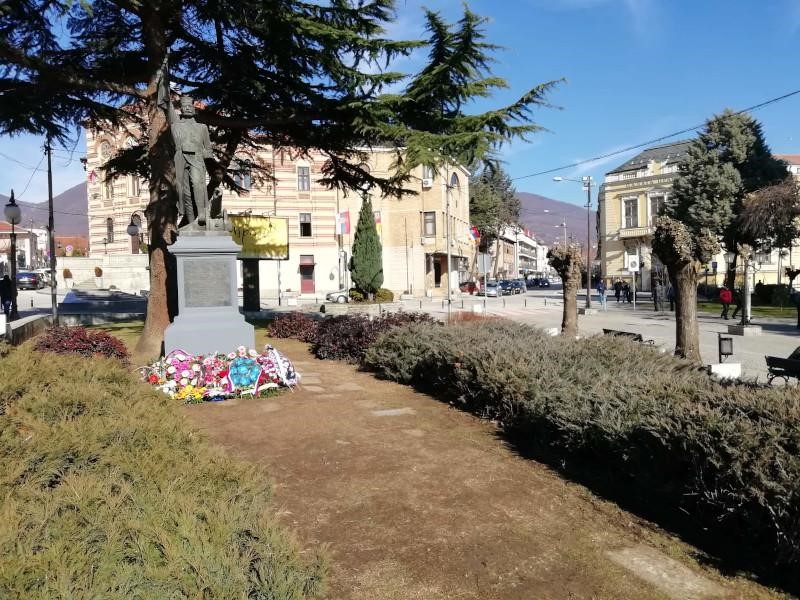
Monument for "Čika Mita"
Almost five-century-long rule of the Ottomans in Vranje ended on 31 January 1878, and the liberation of Vranje represents one of the final stages of the liberation of Serbia from the Turks.
The people of Vranje traditionally celebrate this date as one of the most important for the city. On the occasion of the City Day, every year on 31 January, in the morning, the liberators of Vranje are honored by laying flowers at the monument for “Čika Mita” and a military ceremony is held in the barracks “The First Infantry Regiment of Prince Milos the Great”.
Traditionally, every year on 31 January, tournaments in various sports, exhibitions, book promotions and concerts are held. On the occasion of the City Day, a memorial skiing gathering in mountain Besna kobila, and a march to Osatica near Vranje, the place where most soldiers were buried, who gave their lives in the battles for the liberation of Vranje from the Turks, are traditionally held.
The crown of the celebration is the Ceremonial Academy and the award ceremony “31 January”, which is held in the evening and at which the highest city awards are presented to individuals and institutions for their contribution to social and humanitarian work, in the field of public safety, in the field of education, as well as for contributing to the development of culture.
According to historian Nenad Stojiljković, Vranje was liberated by Serbian forces in 1878, under the leadership of the famous General Jovan Belimarkovic (after whom a street in the city is named), and the liberation struggle began on 26 January and ended with a great battle on 31 January.
Two victories were crucial for entering Vranje and its liberation - the hill of Čavrljuga, north of Vranje and the village of Ranutovac. On the night of 31 January, when the Serbs expected defeat from the Turks, the Turks began to withdraw. Then, General Belimarković issued an order to form an assault group under the command of Major Radomir Putnik, which will continue to pursue the Turks at dawn, in order to liberate Vranje.
At dawn on 31 January 1878, the army, led by Major Radomir Putnik, entered Vranje, after 422, 2 months and 17 days of slavery, and Vranje was liberated with just over 8,000 people. About 63 Turkish and 122 Serbian soldiers were killed in the battles.
According to historian Nenad Stojiljkovic, the Turks only demanded that their lives be spared and that the Serbian army not break into houses.
Stojiljkovic says that no Turkish life was taken during the liberation of Vranje, in terms of the civilian population, there was no mass killing, there was no revenge of the Serbian army against the Turks. The entire property of all Turks, who were in Vranje, was bought by the state - it was not stolen.
Stojiljkovic adds that according to General Belimarkovic's records, "on the day when Vranje was liberated, the fog was as thick as dough."
While it was being celebrated in Vranje, a detachment of Major Radomir Putnik set off in pursuit of the Turkish army towards Bujanovac and Presevo.
After the signing of the peace agreement of the Russian-Turkish war on 3 March 1878, Vranje was supposed to become a part of the Principality of Bulgaria, but the citizens of the city of Vranje wrote to Prince Milan Obrenović and asked that Vranje remained under the Serbian rule.
“Čika Mita” represents a Serbian soldier
The monument to the liberators of Vranje from 1878, known among the people as “Čika Mita”, is located on the Republic Square in the very center of Vranje, between the Municipality building, the Court and the Hotel Vranje.
The people of Vranje started collecting donations for the monument in 1900, and General Belimarković also donated 2,000 dinars at the time. The monument was built in 1903 and it is the work of the Belgrade sculptor Simeon Roksandić.
There is no information about who Čika Mita was, says historian Nenad Stojiljković.
He represents a Serbian soldier, the monument is not dedicated to a specific man. The people of Vranje called him that out of affection. It is not known who gave him the name.
The monument was demolished twice, but was rebuilt again. In World War II, they even tied him to a tank with chains and destroyed him. On that occasion "Čika Mita" had his left arm broken in which he held a rifle, but the people of Vranje left it like that to remind them of the war crimes.
With the names of all the elders, soldiers and volunteers engraved, along with the name of General Belimarković, without a hand and a rifle, Čika Mita still keeps a guard at the same place.
- Total Visitors: 734768


